Ready for pay transparency? Your data probably isn’t.
3 HR regulations, 1 data foundation. Part 1: EU pay transparency.
1/3 – Download the full longread for all directives, including insights and solutions.
The EU Pay Transparency Directive requires employers to be open about pay and objectively demonstrate that their pay policies are gender-neutral. Many organizations treat this as an HR or legal task. The real bottleneck sits elsewhere: in your data.
Among other things, the directive requires you to share salary ranges with candidates, give employees access to pay data broken down by gender and comparable roles, and report on the gender pay gap once you reach 100 employees. On top of that, the burden of proof shifts to the employer: you must be able to explain pay differences objectively.
The problem: your pay data is scattered
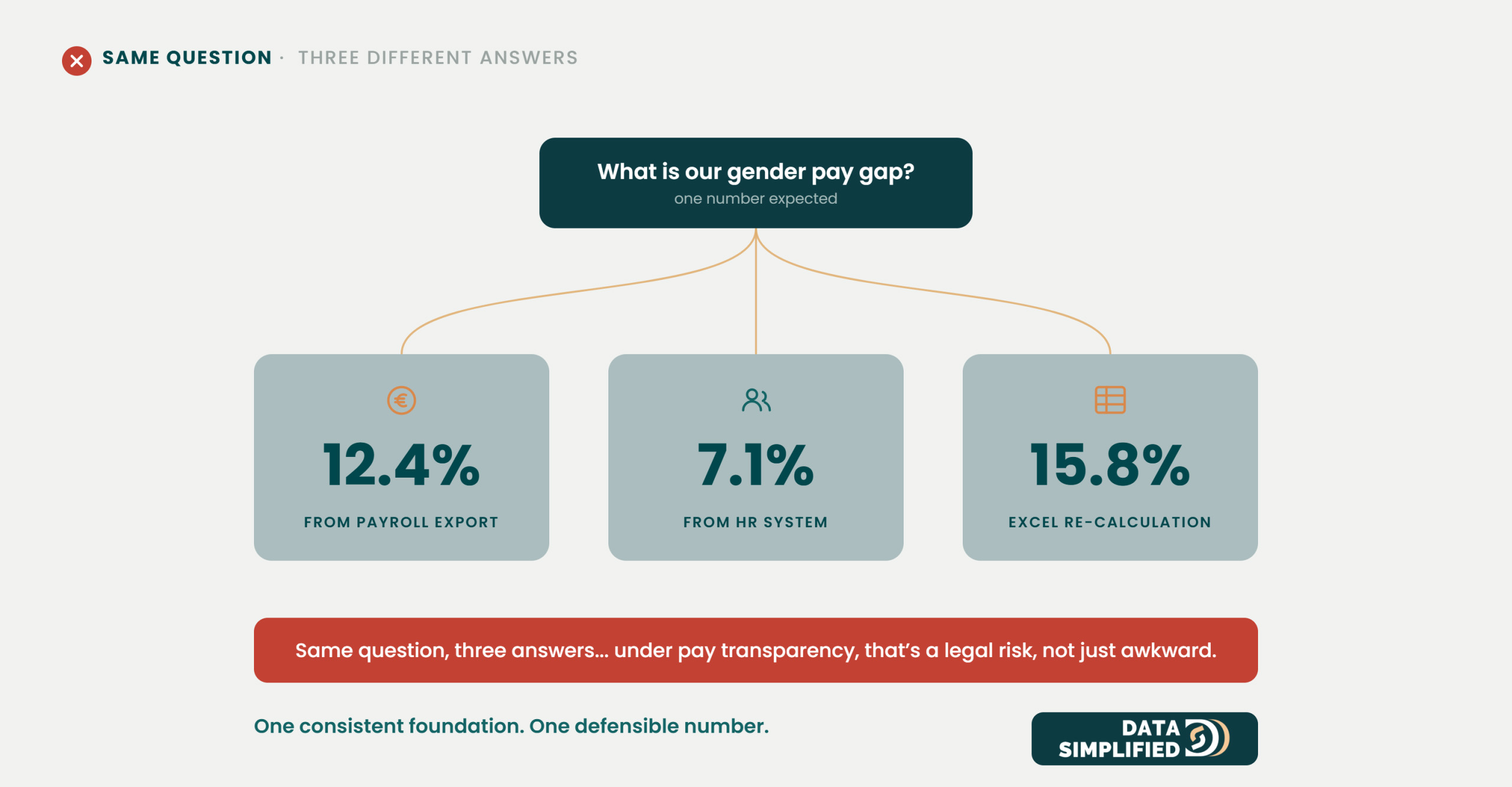
The expectations sound simple, until you ask where that data actually lives. In practice it is spread across payroll tools, HR systems, time tracking and sometimes external partners, each in its own format. Job classifications are inconsistent, pay ranges are rarely formally defined, and the transformation logic ends up in Excel. As a result, the same pay-gap figure can be calculated in several ways. Under this legislation that is no longer just awkward, it carries a legal risk. In a Littler survey (2025), only 24% of organizations feel truly prepared.
The solution: an audit on a consistent data foundation
Do not wait until reporting becomes mandatory. Start a pay-gap audit now on one consistent data foundation, so you map and address any gaps in a controlled way instead of reacting under pressure. An explicit job architecture and documented salary bands are not only needed for this directive. They also form the basis for people analytics and help you attract and retain talent.
KEY TAKEAWAY
Before it becomes an HR task, pay transparency is a data challenge. Make your pay data consistent and auditable, and compliance becomes an outcome instead of a risk.
DOWNLOAD THE FULL LONGread
This is regulation 1 of 3. Want to know how to tackle the sick-leave contact procedure and the EU AI Act too?